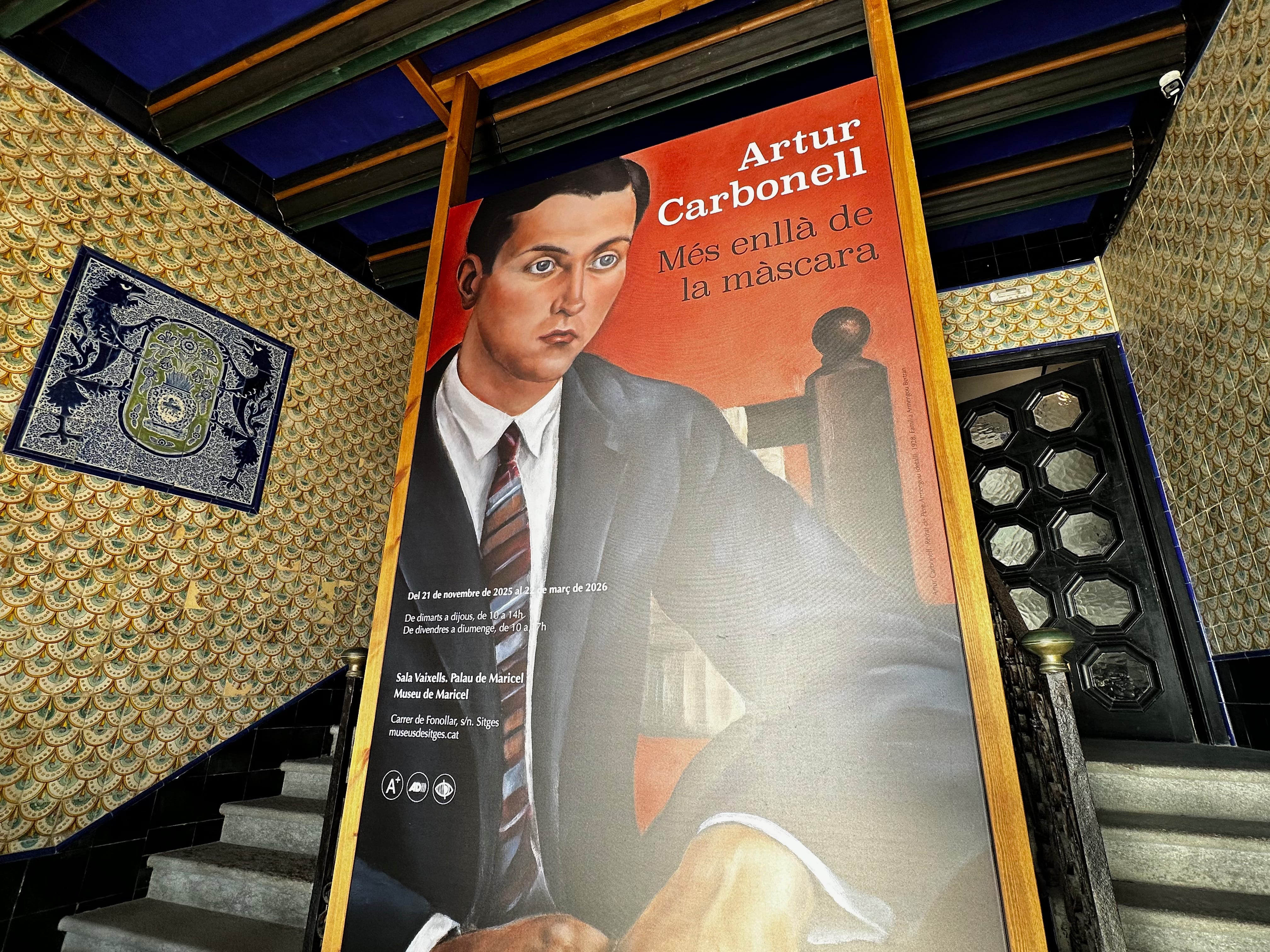
Beyond the Mask, Within the Room
Encountering Artur Carbonell in the Quiet Spaces of Maricel
Seeing Artur Carbonell. Beyond the Mask felt a bit like stepping into a room that whispers rather than shouts. The exhibition didn’t overwhelm me with scale or spectacle. In fact, my first impression was almost the opposite: the space felt modest, the number of works manageable, even restrained. And yet, I left with the unmistakable sense that I’d encountered something far larger than what the walls physically contained.
There’s something disarming about an exhibition that refuses excess. In an era of blockbuster shows and Instagram-sized masterpieces, Beyond the Mask unfolds quietly, asking for attention rather than demanding it. The intimacy of the galleries at the Maricel complex suits Carbonell surprisingly well. His work doesn’t crave monumentality; it thrives in proximity. You lean in. You read. You connect dots. This is not an exhibition you rush through—it’s one you inhabit briefly, like a thoughtfully furnished room.
What gradually becomes clear is that the apparent smallness is deceptive. This is, in fact, the most ambitious retrospective ever dedicated to Artur Carbonell, bringing together over 170 pieces from public institutions and private collections. Paintings, drawings, stage designs, posters, photographs, documents—materials that span decades and disciplines. But instead of presenting them as a dense archive, the curators opt for clarity and dialogue. Carbonell the painter is constantly in conversation with Carbonell the theatre maker, and that tension—between image and performance, stillness and movement—becomes the exhibition’s backbone.
Carbonell himself emerges as a fascinatingly elusive figure. Rooted in Sitges yet deeply connected to European avant-garde currents, he slips easily between labels: magical realist, surrealist, modernist, pedagogue, theatre pioneer. The exhibition’s title, Beyond the Mask, feels especially apt. Masks appear literally in his theatrical work, but metaphorically too—Carbonell seems to resist any single artistic identity. Just when you think you’ve pinned him down as a painter of Mediterranean introspection, he reappears as a radical scenographer or experimental director.
Walking through the exhibition, I was struck by how naturally his visual art feeds into his theatrical imagination. Sketches for stage sets feel like paintings waiting to move; paintings feel like frozen scenes from plays that were never staged. The division of the exhibition across two spaces—the Sala Vaixells and the Museu de Maricel—reinforces this journey from static image to performative space. It’s subtle, but effective, and it mirrors Carbonell’s own creative trajectory.
And perhaps that’s why the exhibition lingered with me longer than expected. Its power isn’t in grand gestures but in accumulation. In the quiet realisation that Carbonell wasn’t simply working across disciplines—he was dissolving their boundaries. The modest scale becomes a strength: it allows the viewer to sense the coherence of a life’s work without being bludgeoned by it.
Leaving the museum, I didn’t feel dazzled, but I felt enriched. Beyond the Mask doesn’t try to impress you; it trusts you. It offers just enough space—for thought, for curiosity, for reconsideration. And in doing so, it mirrors Carbonell himself: understated, complex, and quietly radical.
Arthur Carbonell. Beyond the Mask - The largest retrospective exhibition ever dedicated to Artur Carbonell, which brings together all his facets: painter, theatre director, and set designer from Sitges
From November 21, 2025, to March 22, 2026
Where: Sala Vaixells of the Palau de Maricel – Museu de Maricel
From Tuesday to Thursday, from 10 am to 2 pm, and Friday, Saturday and Sunday, from 10 am to 5 pm


